The pessimistic Austrian view of life is expressed in the verdict:‘Es wird schon schief gehen,’ or, ‘It’s bound to go wrong.’ – Gordon Brook-Shepherd
24 hours in Vienna. It sounds like an action movie, but there was no action unless you count weight gain. Hayley and I subsisted on a tourist diet of schnitzel, streusel, and glühwein. That is, fried food, sweets, and alcohol. We’d only allotted one day for the city because we had to be in Salzburg for an upcoming festival. And because I wanted to visit Hungary we’d be going by way of Budapest, which lay in the opposite direction. Due to our tight schedule we weren’t inclined to be charmed by Vienna and, to our relief, we weren’t. At least not initially. The city lay under gray skies and the Danube River was nowhere to be seen. Our guidebook had warned us that it was not unusual for people to visit Vienna and never catch sight the storied river. Even from atop the Prater Ferris wheel it was hidden from view. Coming from the desert I found it unfathomable that a city wouldn’t give its river top billing. By validating my decision to give the city short shrift I feel that Vienna deserves at least part of the blame. But Vienna didn’t abandon the Danube so much as the Danube abandoned Vienna. The city was originally built on a bank of the river and the main channel shifted over time, moving to the northeast. City authorities worried about losing access to the river and initiated engineering efforts in the Middle Ages to woo her back into her old bed, despite the fact that the Danube would regularly flood and destroy parts of the city. The efforts failed and Vienna had to settle for coaxing a smaller branch of the river into the city. This canal, more governable than her sister, took the place of the wild Danube.
I prepared for our trip by reading a history of the Hapsburg Empire. Hayley prepared by reading Central European folk tales like ‘The Story of the Boy Who Wouldn’t Stop Sucking His Thumb and Had It Snipped Off by the Scissorman.’ Most of the stories were in this vein. A bit on the grim side, but then the reason Hayley had come to Austria in the first place was for the Krampus festival: a Christmas event where luridly-masked demons chase down children in the street and whip them. She really had it in for kids.
What I appreciated about Austrian history was that it’s empire had been assembled through marriage rather than conquest. Well-placed matrimonial bets turned a small, land-locked kingdom into a global empire that at one time included half of Europe and all the Spanish possessions in the New World. There was even an expression regarding Austria’s good fortune: Bella gerant alii, tu felix Austria nube (Let others wage war; you, happy Austria, marry). Too many of these arranged marriages between not-very-distant cousins did have unfortunate consequences. The famous “Habsburg jaw” being one of them. More serious was an assessment of the 19th century Emperor Ferdinand I as “an amiable ninny who would have been dubbed a village idiot had he been born a peasant.” In the end good marriages alone couldn’t maintain the empire and Austria was whittled down by war over the ensuing centuries. Unable to withstand the armies of Napoleon, all the Austrians could do was offer the Archduchess Maria Louisa in marriage to the little general. A time-honored solution. It was hard not to be charmed by such history, at least until the twentieth century when things took a decidedly darker turn. People make fun of France for surrendering to Nazi Germany after fighting for only six weeks, but at least they didn’t enthusiastically welcome them into their country like the Austrians. To this day, footage of hanky-waving crowds welcoming Hitler to Vienna like a groom to his wedding is a source of national shame. There are occasions, George Orwell wrote, “when it pays better to fight and be beaten than not to fight at all.”
After the Second World War those who were found to have worked with the Nazi regime were stripped of their right to vote, but once that right was restored – and because they represented such a large voting bloc – they were courted by the major political parties. Any politician who advocated for de-Nazification risked losing their seat. An embarrassing spectacle ensued as politicians pandered to the worst elements in society in order to get elected. It sounded familiar, like Nixon’s Southern Strategy and Trump’s currying favor with white supremacists, religious bigots, and other “good people”. This willful amnesia about the past led to the election of Kurt Waldheim as president in 1986. Waldheim had joined the Nazi party in his youth even though his father had been arrested by the Gestapo, and it was later revealed that he’d participated in war crimes, all of which damaged the country’s Sound of Music image. He defended himself by declaring, “Yes, I knew [about the crimes]. I was horrified. But what could I do? I had either to continue to serve or be executed.” It was, in effect, an unhappy marriage.
My mother had passed away the previous year and I was only now beginning to overcome the guilt associated with doing anything enjoyable. One of my friends told me that it was a storybook ending, how I’d flown home just in time to hold my mother’s hand before she passed away. It didn’t feel that way though, because by the time I arrived she was already too far gone to recognize me. I sat by her bedside and began to sing to her in French. A lullaby. I’m not sure why I did it. Maybe I thought she’d like to hear the language she grew up with. Maybe it was because she could never resist correcting my French and I half expected her to sit up and give me a reproving look: “Now James, you know that’s not how to say it.” But my friend was right, it ended well. We were on the best of terms. I’d long ago forgiven her for not being perfect and she’d almost forgiven me for not having children.
After landing in Munich, Hayley and I traveled to Vienna by train. The hotel was something new, at least for me. Everything was done by smartphone: booking, checking in, getting into the hotel, getting into the room, and checking out. I could envision the commercial for a place like this: “So convenient! No keys to lose or wasted time at check-in! Just scan and go!” The concept was right out of Tomorrowland, a future where machines do all the heavy lifting and we just sit around in silver jumpsuits reading the newspaper. In practice it felt more like an episode of Black Mirror. There was no one to greet us, only directional signs to move us along. The halls were narrow and quiet and everything was painted white. It conjured disquieting images of hospitals and insane asylums. We followed the arrows and then scanned a QR code to enter our cell. The system worked perfectly, and it was depressing. The message I got from the hotel was, “We don’t even want to see you.” Talk about an absentee landlord.
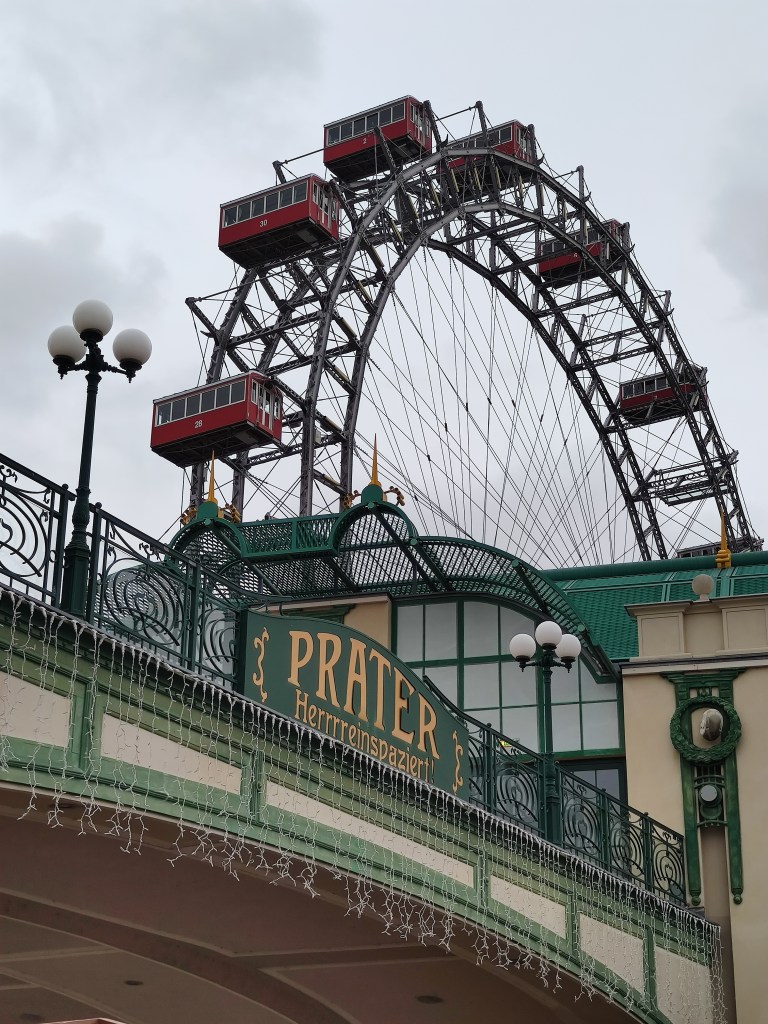
I wasn’t interested in visiting cathedrals. Too much water under the bridge, as they say. Any mention of religion just calls to mind con-men and their mega-churches, swindling the poor and the desperate. An American reaction, no doubt. Our day in Vienna started with a trip to the Prater, an amusement park in the middle of the city. I’d recently watched The Third Man and wanted to take a spin on the Ferris wheel that Orson Welles had ridden with Joseph Cotton. It was wintertime and most of the rides were closed, but a few families still wandered the grounds, their kids full of excitement despite the weather, and the Ferris wheel was turning. I bought two tickets and waited for one of the gondolas to stop and open its doors. They were in the shape of train carriages and some of them featured long wooden tables that could be set up, banquet-style, for special events. We stepped aboard and were lifted hundreds of feet above Vienna, where it paused for us to observe the ants below. This is where Harry Lime made his pitch to Holly Martins in The Third Man, offering him a piece of the action in his criminal racket. Embodying the cynical world of a defeated postwar Vienna, still under Allied occupation, he looks at the moving dots and tells Holly, “Nobody thinks in terms of human beings. Governments don’t, so why should we? They talk about the people and the proletariat, I talk about the suckers and the mugs. It’s the same thing. They have their five-year plans and so have I.” He’s charming, almost persuasive, until you remember he’s been stealing penicillin and selling it to hospitals in adulterated form, profiting from suffering and death. Harry Lime’s criminal enterprise is already crumbling at this point. The walls are closing in. “I’m only safe in the Russian zone,” he laments. In a final deplorable act he tries to make a mug of his old friend, but Holly wises up and betrays Lime to the police. No heroes, no happy ending, and no one gets the girl. Just a guy refusing to be a patsy. Yet somehow, it’s a great story.
Central Europe is known for its Christmas markets and Vienna has several, albeit described as “kitschy and twee” on its own website. Nevertheless, when in Rome. We dove into the most famous, the Wiener Christkindlmarkt on the Rathausplatz. The open space in front of the town hall featured a broad candy-striped arch, a carousel, and a Christmas tree, all ablaze in lights. Lining the base of the town hall and spread around the square were dozens of wooden booths, each one resembling a nook for a nativity scene. Vendors huddled inside by space heaters and sold Christmas ornaments, woolen socks, snow globes, and wooden figurines so Bavarian you’d almost believe they weren’t made in China. Then there were the food vendors selling Schaumrolle, Buchteln, Bratapfel, and Zuckerwatte, all of them sweets. So many sweets the air itself seemed cloying. It was also cold so our first stop was a booth that sold glühwein, a hot spiced wine. Other booths sold Weihnachts-punsch, a catchall term for any alcoholic punch. Basically moonshine. It was a pleasant thing to walk tipsily among smiling people at Christmastime, everyone lost in their memories of Christmases past, of childhood and family. Forgotten for a moment were thoughts of war and other crises. No easy feat in an age of doomscrolling. I know because I keep a file of unsettling headlines:
ARCTIC ZOMBIE VIRUSES IN SIBERIA COULD SPARK TERRIFYING NEW PANDEMIC
ATLANTIC OCEAN CIRCULATION NEARING DEVASTATING TIPPING POINT
THE ‘DOOMSDAY GLACIER’ IS COMING FOR US ALL
I congratulated myself on actually relaxing during my vacation instead of worrying about the approach of a terrifying, devastating, doomsday. Besides, I’d be more amenable to the end of the world in the morning when I woke with a glühwein hangover.
 James Perry